He Who Breaks the People’s House Without Permission Shall Pay to Rebuild It.
The White House does not belong to Donald Trump. It did not belong to Joe Biden, Barack Obama, George W. Bush or any of their predecessors. Presidents are temporary occupants entrusted with preserving a national property that belongs to the American people.
That principle is no longer merely historical tradition. In August 2026, the United States Court of Appeals for the District of Columbia Circuit halted aboveground construction of Trump’s planned ballroom. Its words could not have been clearer: “Each President is a temporary tenant, not the owner, of the White House.” The court concluded that a president may not fundamentally reshape the White House without congressional approval and declared that construction of such a ballroom “is for Congress to decide and is not a matter for Executive self-help.” Reuters reported the ruling and linked the court’s opinion.
That ruling supports what common sense already tells us: A president does not receive the keys to the White House with permission to demolish whatever stands in the way of his personal vision.
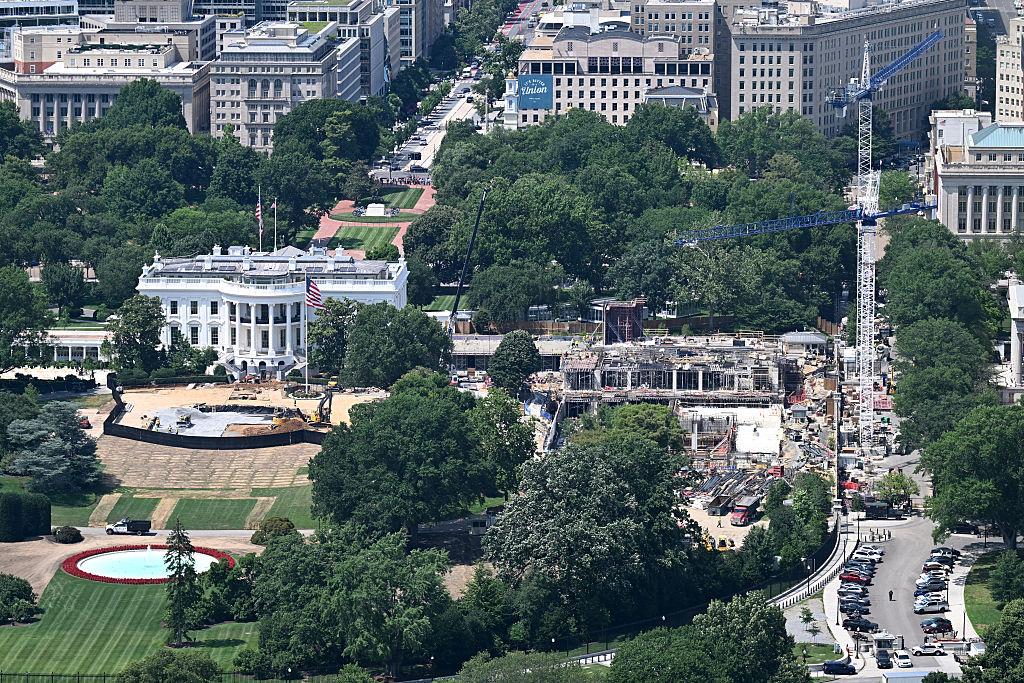
The East Wing was not disposable office space. Its origins reached back to Theodore Roosevelt’s 1902 renovation. In 1942, President Franklin D. Roosevelt oversaw its expansion into a two-story structure containing a formal entrance, government offices and an underground wartime shelter. It later housed the offices of the first lady and welcomed generations of Americans entering the White House for public tours. It was part of the architectural and institutional history of the presidency. The White House Historical Association documents that history.
Trump had the East Wing demolished in 2025 to make way for a massive ballroom project. The original estimate was approximately $200 million. The reported cost of the East Wing construction later rose to about $600 million, while the Trump administration’s collection of planned projects across the White House grounds—including security construction, a visitor facility, a helipad and surrounding improvements—was reported to exceed $900 million. According to records reviewed by The Washington Post, taxpayers were expected to cover most of that broader expense, despite Trump’s earlier assurances that private donors would pay for the ballroom. The Post has reported a total exceeding $927 million.
The constitutional problem is straightforward. Article I gives Congress control over federal spending, while Article IV gives Congress authority over federal property. The president executes the laws; he does not possess a private construction account or an unrestricted power to remake public landmarks.
The Supreme Court established the controlling separation-of-powers principle in Youngstown Sheet & Tube Co. v. Sawyer in 1952. President Harry Truman attempted to seize the nation’s steel mills during the Korean War, claiming that national necessity justified his action. The Court rejected that claim because neither the Constitution nor Congress had granted him that authority. Presidential power, the Court made clear, does not arise merely because a president believes his objective is important.
Trump’s claimed authority is even weaker when exercised against Congress’s constitutional control over federal property and spending. As the appeals court stated, national security is not an automatic “get-out-of-law-free card.”
History also exposes the contrast. When the White House became structurally unsafe during Truman’s presidency, Truman asked Congress to establish a commission and authorize its reconstruction. Congress approved the project and created a six-member commission to supervise it. The building was gutted and rebuilt between 1948 and 1952—but through an accountable public process involving plans, appropriations and congressional oversight. The Truman Library preserves the commission’s official records.
Trump followed no comparable path before destroying the East Wing.
Whether a court can require Trump personally to reimburse the government remains legally uncertain. In Nixon v. Fitzgerald, the Supreme Court granted presidents broad immunity from civil damages for conduct within the “outer perimeter” of official responsibility. No court has yet ruled that Trump is personally liable for the East Wing’s reconstruction.
Congress, however, is not powerless. It can investigate the demolition, trace every transferred dollar, reject improperly funded construction, demand restitution where authorized, and legislate consequences for unauthorized destruction of federal property. It can also refuse corporate donor money that buys access, influence or recognition inside the People’s House.
My conclusion is therefore both moral and political: If Donald Trump chose to destroy public property without lawful authorization, the American people should not inherit his bill. He should bear the cost of restoring what he ordered destroyed.
Like an unsupervised child in a department store, he broke it. Now he should pay for it.